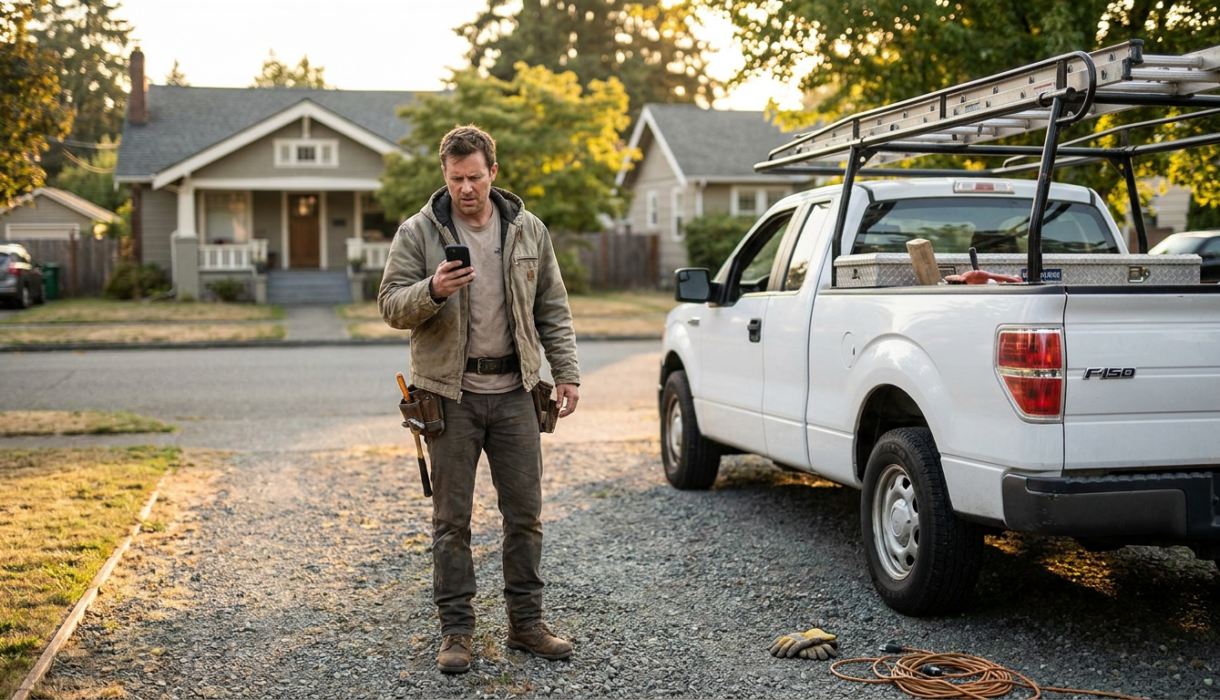
How Fast Should a Contractor Call Back a New Lead? (The 5-Minute Rule Explained)
Posted in :

I was talking to a plumber in Marysville a while back. Good guy, solid reputation, busy schedule. He told me he usually calls leads back “same day, maybe the next morning if it comes in late.” He genuinely thought that was fine.
It is not fine. And the data on how fast a contractor should call back a new lead is pretty brutal about why.
Here is what the research says, what most contractors actually do, and what you can do about it without hiring a full-time receptionist.
The Short Answer: Call Back Within 5 Minutes
If you take nothing else from this post, take this: respond to a new lead within 5 minutes. That is not a nice-to-have. That is the threshold where the numbers change dramatically.
What the Research Actually Says About Lead Response Time
A Harvard Business Review study tracking 2,241 U.S. companies found that firms responding within 1 hour are 7 times more likely to qualify leads than those who wait longer. MIT research paired with that work shows that responding within 5 minutes makes you 100 times more likely to make contact and 21 times more likely to qualify the lead compared to waiting 30 minutes.
Velocify found that calling a lead within one minute of their inquiry boosts conversion rates by 391%. That is not a typo.
The window is short and it closes fast.
How Lead Quality Decays the Longer You Wait
Think of a new lead like ice on a hot day. It starts solid and melts fast. The longer it sits, the less you have to work with.
The Conversion Rate Curve: From 70% to 2%
Here is what the decay curve actually looks like, based on data from Conversica:
- Within 5 minutes: ~70% conversion rate
- Within 30 minutes: ~50%
- Within 1 hour: ~20%
- Within 24 hours: ~5%
- After 24 hours: ~2%
By the time you call someone back the next morning, you are working with roughly 2 cents on the dollar compared to what that lead was worth five minutes after they submitted it. That is the lead decay curve in action.
What Most Contractors Actually Do (And Why It Costs Them Jobs)
Here is the gap that should make every contractor uncomfortable.
The 42-Hour Average: A Self-Inflicted Competitive Disadvantage
According to LeadAngel’s speed-to-lead data, only 0.1% of field service businesses respond to a new lead within 5 minutes. The industry average response time is 42 to 47 hours.
In an audit of 2,241 U.S. construction companies, 24% took more than 24 hours to respond and 23% never responded at all. Nearly a quarter of businesses just ghost potential customers entirely.
If you call back within an hour, you are already ahead of most of the competition. If you call back within 5 minutes, you are in a very small group. That group wins a lot of jobs.
After-Hours Leads: The Biggest Missed Opportunity for Contractors
Most contractors think about lead response in the context of business hours. That is the wrong frame.
Why 55% of Calls Come In When You’re Not at Your Desk
Home service companies receive 55% of their total call volume between 5 PM and 9 AM, plus weekends. Homeowners research contractors after dinner. They call about a leak on Saturday morning. They make booking decisions on Sunday evenings.
Most businesses send those calls to voicemail. That is a mistake.
What Happens When a Lead Hits Your Voicemail
About 80% of callers hang up without leaving a message if they do not reach a live person. And 85% of the people who do reach voicemail will never call that same business back. They just scroll down the Google results until someone picks up.
That is not a maybe. That is what the data shows. A missed call is usually a lost job, not a delayed one.
If you want to understand what a missed call text-back system actually does and what it costs to set up, I wrote a breakdown here: Missed Call Text Back for Contractors: What It Is and What It Costs.
The Right Follow-Up Strategy: How Many Times Should You Try?
Speed gets you in the door. Follow-up keeps you from losing the job to the next guy.
5 Touches in 7 Days: The Proven Follow-Up Cadence
80% of sales require 5 or more contact attempts. Most contractors quit after one or two. That means the contractor who keeps trying, politely and consistently, wins a disproportionate number of jobs just by showing up when others stopped.
The right cadence is at least 5 touches across the first 7 days. A mix of calls and texts. Not aggressive, just persistent. And 82% of consumers say they want a business to reply within 10 minutes of reaching out, so the early touches matter most.
Call Plus Text: Why the Channel Mix Doubles Your Contact Rate
The best first move is an instant automated text acknowledgment followed by a personal call within 5 minutes. Using both channels together doubles your contact rate compared to calls alone.
The text buys you goodwill and keeps the lead warm while you wrap up whatever you are doing. The call closes the loop and starts the real conversation.
Why Speed Matters Even More on Platforms Like Angi and Thumbtack
If you are buying leads from Angi, Thumbtack, or Google LSA, the speed problem gets worse, not better.
On Angi, multiple contractors receive the same lead at the same time. The first one to engage meaningfully wins. On Thumbtack, customers are literally comparing several pros side by side. Response speed is the primary differentiator because everyone has decent reviews and similar pricing.
For a small contractor in Snohomish County, this multi-platform dynamic means a slow callback does not just lose you a job. It directly funds a competitor who was faster. You paid for that lead and handed the job to someone else.
How to Actually Respond in 5 Minutes Without Dropping Your Tools
This is where most contractors get stuck. They agree that 5 minutes is the goal. They just cannot figure out how to do it when they are under a sink or on a roof.
Automated Acknowledgment Texts as a Bridge to a Personal Call
The answer is not hiring a receptionist for every shift. The answer is automation that handles the first response instantly, then flags you or your office to follow up with a real call.
An automated text goes out the moment a lead comes in: something like “Hey, this is [Your Name] from [Company]. Got your message and will call you shortly.” That one message resets the clock in the customer’s mind. They know someone is coming. They are less likely to call the next guy.
This is exactly what the system I build for contractors does. An AI receptionist or voice agent handles incoming calls and after-hours inquiries. Automated SMS and email follow-up starts immediately. Missed-call text-back fires the moment a call goes unanswered. And everything runs on one platform so there is no juggling five different tools.
The goal is simple: no lead falls through the cracks because you were on a job. That is the whole point.
If you want to see where you stand right now, you can check your AI visibility for free at aivisibilitycheck.online. It takes a couple of minutes and shows you how your business looks to AI-driven search tools that more and more homeowners are using to find contractors.
Frequently Asked Questions About Contractor Lead Callback Speed
How fast should a contractor call back a new lead?
Within 5 minutes for best results. Within 1 hour at the absolute outside. After that, your odds of qualifying the lead drop dramatically.
What if the lead comes in after hours?
A lead submitted at 11 PM does not expect an immediate call. But they do expect acknowledgment. An automated text right away, then a call first thing in the morning, is the right move.
How many times should I follow up before giving up?
At least 5 times across the first 7 days. Most sales require 5 or more contact attempts, and most contractors stop after one or two.
Does the first responder really win that often?
Industry research indicates 78% of customers buy from the first responder. That number alone should change how you think about callback time.
What about leads that are not ready to buy yet?
63% of leads who are not initially ready to buy eventually do convert when they go through a proper nurturing process. That means follow-up over time matters, not just the first call.
Speed to lead is not a marketing concept. It is a field operations problem with a direct line to your revenue. The contractors who solve it win more jobs with the same budget. The ones who do not keep wondering why their close rate is low.