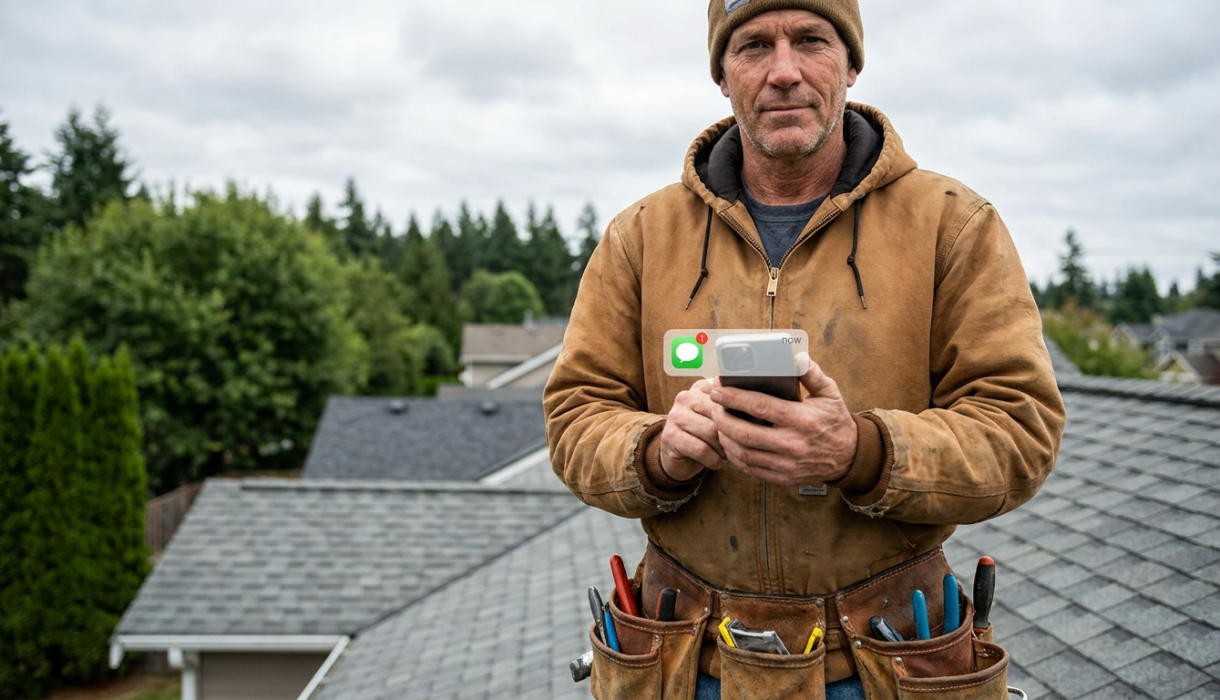

I talk to solo contractors all the time who are doing great work and still struggling to grow. When I dig in, the problem is almost never their skills or their pricing. It’s that they’re losing leads before they ever get a chance to talk to them.
The best way for a solo contractor to never miss a lead again is not about working harder or hiring a full-time receptionist. It’s about building a simple automated system that responds instantly, even when you’re on a roof in Marysville with your phone in your pocket.
Here’s what that system looks like, why it matters, and how to get it running.
Why Solo Contractors Keep Losing Leads (Even Good Ones)
A 2024 analysis across 58 industries found that home service companies miss 62% of their inbound calls. That’s the worst rate of any industry tracked. And before you think “well, I call back pretty fast”, 85% of callers won’t try again if they don’t reach you on the first attempt.
You’re not losing leads because you’re bad at your job. You’re losing them because you’re actually doing your job when they call.
The Real Cost of a Missed Call
Invoca analyzed over 60 million phone calls and found that each missed call costs a home service business roughly $1,200 in lost revenue. Across a year, that adds up to $126,000 or more for a small operation. That’s not a rounding error. That’s a truck payment, a helper’s salary, or a real vacation.
And that number doesn’t include referrals. Every customer you don’t book is a person who won’t refer you to their neighbor in Lake Stevens or their coworker in Everett.
Why Voicemail Doesn’t Save You
Here’s the thing about voicemail: 80% of callers won’t leave one. They just hang up and call the next contractor on the list. Even if someone does leave a message, by the time you listen to it and call back, they’ve already booked with whoever answered the phone first.
Voicemail feels like a safety net. It’s really just a place where leads go to die quietly.
The 5-Minute Rule: Speed to Lead Is Everything
There’s a well-known study from Harvard Business Review and MIT that contractors need to hear. Companies that respond to a new lead within 5 minutes are 21 times more likely to qualify that lead compared to those who wait 30 minutes. Wait an hour and you’re 7 times less likely to even get the person on the phone.
That’s not a small difference. That’s the difference between a booked job and an empty Tuesday.
What the Data Says About Response Time and Conversion
ServiceTitan’s 2025 Home Services Benchmark Report put a conversion number on it. Contractors who respond within 2 minutes convert 62% of leads. The industry average response time is 42 minutes, and that group converts only 28% of leads. So the gap between fast and slow isn’t just speed. It’s more than double the booked jobs.
Only 12% of contractors respond within 5 minutes, according to Hatch’s analysis of over 132,000 HVAC speed-to-lead campaigns. The most common response time was one full day. That’s the competition you’re up against. If you can respond fast, you win most of the time by default.
I wrote a deeper breakdown of the 5-minute rule if you want to go further: How Fast Should a Contractor Call Back a New Lead?
The Best System for a Solo Contractor to Never Miss a Lead
You don’t need a full-time office person. You need a system that runs while you’re working. Here’s what that looks like in four steps.
Step 1: Set Up Automated Missed-Call Text-Back
This is the single highest-impact thing a solo contractor can do. When someone calls and you can’t answer, the system automatically sends them a text within 60 seconds. Something like: “Hey, this is [Name] with [Company]. I’m on a job right now but I’ll call you back shortly. What can I help you with?”
That one message does two things. It tells the lead you’re real and responsive. And it captures their attention before they dial the next number. Contractors using missed-call text-back capture 30 to 40% more leads without answering the phone more often. SMS has a 98% open rate, and 90% of texts are read within 3 minutes. No email comes close to that.
Step 2: Add After-Hours Coverage
Hatch’s 2025 data found that home service companies without after-hours automation lose about 34% of their leads to next-day delays. For a business doing 80 leads a month, that’s roughly $140,000 a year walking out the door overnight.
Think about who calls at 10 PM. It’s a homeowner with a busted water heater or a furnace that stopped working. They are not comparison shopping. They want someone who will show up. If your after-hours response is silence, they’ll find someone who isn’t silent.
After-hours automation means your system is texting back, capturing their information, and setting expectations around when you’ll call, even while you sleep.
Step 3: Use a Simple CRM with Automated Follow-Up Sequences
Most solo contractors track leads in their head or in a notes app. That works until it doesn’t. A home service CRM gives you a pipeline you can actually see, and more importantly, it can run follow-up sequences automatically.
The data on follow-up is brutal. 44% of salespeople give up after one attempt, but 80% of sales take at least 5 touches to close. An automated follow-up sequence solves this. Send an email at day 2, an SMS at day 5, a final check-in at day 10. You set it up once and it fires on its own. You’re not chasing people manually. The system does it.
Contractor lead follow-up automation like this doesn’t require a big tech background. It requires the right platform with the right setup.
Step 4: Consider an AI or Virtual Receptionist
An AI virtual receptionist answers calls, greets the caller, asks qualifying questions, and either books an appointment or sends the info to your CRM. It handles inbound call coverage 24 hours a day without a lunch break or a sick day.
Live virtual receptionists (real humans working remotely) run $245 to $1,640 per month depending on call volume. AI-powered answering starts around $25 per month at the basic end. AI is 60 to 85% cheaper at equivalent call volumes.
For a solo contractor in Snohomish County where new housing developments keep pushing demand up, having something that answers every call, qualifies the lead, and logs it automatically is a real competitive edge.
How Much Does It Cost to Never Miss a Lead?
This is where most contractors get stuck. They look at the tools and think it’s a lot to manage. And honestly, if you try to stitch together five separate subscriptions yourself, it is a lot to manage.
The smarter move is having everything on one platform. Missed-call text-back, after-hours automation, the AI receptionist, the CRM, the automated follow-up sequences, the pipeline management. One login. One monthly cost. No juggling.
That’s exactly what I build for contractors through KIKK Ventures. It runs on Go High Level, which is built for this kind of work. I set it up, configure it for your business, and manage it so you don’t have to become a software person on top of everything else you’re already doing.
The cost of the system is a fraction of what a single missed job costs. And Snohomish County is growing fast. The county added 9,600 residents between 2024 and 2025. Marysville alone is home to around 72,000 people. The leads are out there. The question is whether your system is catching them.
What Happens When You Put the System Together
When all four pieces are running, here’s what your day looks like. You’re on a job. A call comes in. You can’t answer. The system texts back in under 60 seconds. The lead replies. The CRM captures their info and starts a follow-up sequence. If they call after hours, the AI receptionist handles it. By the time you check your phone on a break, you have a new lead in your pipeline with their contact info, what they need, and when they want to be called.
You didn’t miss anything. You didn’t have to stop working. And your conversion rate looks a lot more like 62% than 28%.
That’s the best system for a solo contractor to never miss a lead again. Not hustle harder. Build the system once and let it work.
Frequently Asked Questions
What is missed-call text-back for contractors?
It’s an automated system that sends a text message to a caller within 60 seconds of a missed call. It keeps the lead engaged and captures their attention before they move on to the next contractor.
What is the 5-minute rule for contractors?
Research from Harvard Business Review and MIT found that responding to a lead within 5 minutes makes you 21 times more likely to qualify that lead compared to waiting 30 minutes. Speed to lead is one of the biggest factors in conversion rate for home service businesses.
Do I need a CRM as a solo contractor?
If you’re tracking leads in your head or on paper, you’re losing follow-up opportunities. A contractor CRM with automated follow-up sequences means every lead gets the right message at the right time without you doing it manually.
Is an AI receptionist better than a live answering service?
For solo contractors, AI is usually the right call. It costs 60 to 85% less than a live virtual receptionist at equivalent call volumes, it’s available 24 hours a day, and it integrates directly with your CRM and follow-up sequences.
How do I get started?
The first step is knowing where you stand. You can run a free AI visibility check here to see how your business shows up online and where leads might be slipping through. Or if you’re ready to talk about a done-for-you setup, you can reach me at kentheaiguy.net.