What Happens to Leads That Call After Business Hours (And How Much It’s Costing You)
Posted in :

A few months ago I talked to a roofing contractor in Marysville who couldn’t figure out why his phone was ringing but his schedule wasn’t filling up. He had decent Google reviews, a solid Google Business Profile, and he was getting calls. But the jobs weren’t converting.
When we dug into it, the answer was simple and painful. Most of his calls were coming in after 5 PM. He had voicemail. That was it.
If you’ve ever wondered what happens to leads that call after business hours, I can tell you exactly what happens. Most of them are gone by morning.
Most After-Hours Leads Are Gone Before You Open the Next Morning
This isn’t a theory. The numbers are consistent across multiple studies, and they’re worse than most owners expect.
How Many Leads Actually Call Outside Business Hours?
About 52% of leads come in outside standard business hours, according to GreetNow’s 2025 research. For home services specifically, that number runs between 40% and 60%. Think about that. You could be missing roughly half your inbound leads simply because they called when no one was there to answer.
People get home from work, something breaks, they start searching. It’s 7 PM on a Tuesday. It’s Saturday afternoon. It’s Sunday morning after a storm rolls through Snohomish County and they’ve got a leak. That’s when they call.
What Callers Do When No One Answers
Here’s where it gets expensive. According to research from 411 Locals and Invoca, 85% of callers who reach voicemail never call back. And 62% of unanswered callers contact a competitor instead.
They’re not waiting. They have a problem, they want it solved, and there are five other contractors showing up in the same Google search. If you don’t answer, someone else will.
BrightLocal’s 2025 Local Consumer Review Survey found that most small businesses lose about 27% of potential customers who call outside business hours. That’s more than one in four leads, gone before your workday even starts.
The Real Cost of Missed After-Hours Calls
Let’s put a number on this because it makes the problem impossible to ignore.
What a Missed Call Is Actually Worth in Lost Revenue
A contractor missing just 5 to 10 calls per week at an average job value of $500 can lose between $45,000 and $120,000 annually, according to a 2024 analysis from getaira.io. That’s not a rounding error. That’s a truck payment, or two, every single month.
Small businesses miss 62% of incoming calls overall, which one study estimated costs an average of $126,000 per year in lost revenue. Even if your situation is less extreme, the math is hard to argue with.
Why Voicemail Alone Is Not a Strategy
Voicemail is what happens when you don’t have a strategy. It’s the default, not a solution.
About 60% of callers won’t even leave a voicemail. They hang up and move on. And according to Podium’s Small Business Communication Survey from 2025, one-third of small businesses never follow up on missed calls at all. The voicemail notification gets cleared and the lead is permanently gone. Not because the owner doesn’t care, but because there’s no system in place to catch it.
Why Response Speed Determines Whether You Win or Lose the Lead
Even if a caller does leave a voicemail, when you call back matters enormously.
The Speed-to-Lead Data Every Business Owner Should Know
Harvard Business Review found that firms responding within an hour were nearly 7 times more likely to qualify a lead than those who waited longer, and 60 times more likely than those who waited 24 hours. Sixty times.
The average B2B lead response time is 42 hours, according to Kixie’s 2026 data. That’s nearly two full business days. If you’re calling back the next morning, you’re already behind most of your competition, and that’s if you’re being prompt.
Same-Night vs. Next-Morning Response: The Conversion Gap
GreetNow’s 2025 research found that after-hours leads receiving a same-night response have an 85% contact rate. Next-morning response drops that to 35%.
That is a massive gap. A lead that came in at 9 PM and gets an auto-response plus a call at 9 AM is still warmer than one that gets nothing until you check your voicemail at lunch. The lead that called at 9 PM doesn’t necessarily expect you to call back at 9 PM, but they do expect to hear from you, and they expect it fast.
Four Ways to Handle After-Hours Calls (And What Each One Costs You)
There are really only four options here. Let me walk through each one honestly.
Voicemail Only
This is where most small businesses are right now. It costs nothing to set up and it costs you 85% of your after-hours callers. If you’re going to keep voicemail, at least record a message that sets expectations and tells callers you’ll follow up first thing in the morning. That’s the bare minimum.
Live Answering Service
A live answering service puts a real person on the phone under your business name. They can take messages, qualify leads, and book appointments. This works well for complex or sensitive calls. Cost runs roughly $250 to $900 per month depending on volume and what you need them to do. The downside is that it’s an ongoing operational cost and quality can vary.
AI Answering Service
An AI answering service answers every call instantly, 24 hours a day, 7 days a week. It can handle FAQs, qualify the lead, book an appointment, and route genuine emergencies. No per-minute charges for after-hours calls, no hold times, no sick days. Pricing typically runs $29 to $250 per month. For a lot of home service businesses, this is where the math starts making sense.
If you want a deeper look at how these work and what they actually cost, I wrote about that here: AI Voice Agents for After-Hours Contractor Calls: What They Cost and How They Work.
Hybrid Model
A hybrid setup uses AI to handle the routine volume and routes complex or sensitive calls to a live agent. You get the speed and consistency of automation with a human backstop when it matters. This is the best of both approaches for businesses with higher call volume or more complicated services.
What Best-Practice After-Hours Lead Handling Actually Looks Like
Here’s what good looks like in practice.
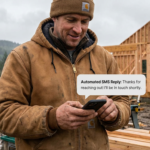
A lead calls at 11 PM. The call is answered immediately, either by a live person or an AI agent. The caller gets their question addressed, or at minimum gets acknowledged and knows exactly when to expect a callback. An automated SMS goes out right away confirming that someone will follow up in the morning. At 9 AM, a scheduled call goes out as a priority. Weekend leads get Monday morning priority routing.
That’s it. That’s the whole system. It’s not complicated in concept, but it requires the pieces to actually be connected and working together. The auto-response, the CRM, the scheduling, the follow-up sequence. If any one piece is missing, leads fall through the gap.
One thing worth noting: your Google Business Profile is often where these after-hours leads find you in the first place. If that profile isn’t optimized, you’re not even getting the calls you could be. I covered the details on that here: Google Business Profile Optimization for HVAC Contractors: A Step-by-Step Guide to Ranking in the Local Pack.
Stop Losing After-Hours Leads: What to Do Right Now
If you’re a contractor or home service business in the Marysville or Snohomish County area and you’re not handling after-hours calls with something better than voicemail, you’re leaving real money behind every single week.
The problem isn’t that you don’t care. It’s that the pieces aren’t connected. An AI answering service, a missed-call text-back, a follow-up sequence, and a properly optimized Google Business Profile all need to work together on one platform. When they do, after-hours lead response stops being a gap and starts being a competitive advantage.
That’s exactly what I build and manage for local business owners through KIKK Ventures. You don’t have to figure out which tools to buy, how to connect them, or how to maintain them. I do that.
If you want to start by seeing how your business shows up in AI search and local results right now, run a free check at aivisibilitycheck.online. It takes about two minutes and gives you a real picture of where you stand.